A gemstone parcel is rarely a simple stock row for very long.
It may start as one purchased lot: 42.70 carats of mixed sapphires, one supplier invoice, one total purchase cost, one internal parcel number. A week later, part of that parcel is shown to a customer on memo. A few stones are sold. Some are returned. A smaller group is split out because the quality is better than the rest. Later, two matching groups may be merged for a buyer who wants a consistent layout.
On paper, each step feels ordinary. In the inventory record, each step changes the cost story.
That is where many gemstone businesses begin to lose confidence in their numbers. The team can still see stones in the safe. They can still find old invoices. They may even have a spreadsheet that says how many carats should remain. But when someone asks, "What is the real cost of this smaller parcel now?" or "What margin did we make after the partial sale?" the answer becomes harder than it should be.
For loose-stone dealers, parcel tracking is not an administrative detail. It is the difference between knowing your stock and only recognizing it.
Why generic inventory rows are not enough
A normal retail inventory system is built around a familiar idea: one SKU, one quantity, one cost, one selling price. That works reasonably well when stock items are interchangeable. If a shop has 20 identical boxes of packaging, one row can represent the group.
Gemstone parcels behave differently.
Two stones from the same purchase can have different color, size, clarity, treatment, origin, appeal and selling potential. Even when the parcel is priced as a lot, the dealer may later separate the best stones, sell a few pieces individually, keep some as pairs, send some on memo, and discount the rest.
The original lot cost still matters, but it no longer answers every business question.
If the system only stores one cost value against one row, the team eventually starts solving problems outside the system. Someone adds spreadsheet notes. Someone keeps a separate costing file. Someone writes an adjusted price on a label. Someone remembers that a particular stone was "from the better part of that parcel." These workarounds may feel manageable at first, but they do not scale well across customers, memos, returns and staff. This is where spreadsheets start to break down as the main inventory workflow.
The partial sale problem
Partial sales are one of the most common places where costing gets messy.
Imagine a dealer buys a 100-carat parcel for $12,000. The average cost is $120 per carat. A customer later buys 18 carats from the parcel for $4,500. On the surface, the calculation looks easy: remove 18 carats and keep 82 carats in stock.
But the business question is not only "How much quantity remains?"
The questions are:
- Was the sold portion representative of the parcel, or did it contain the better stones?
- Should the remaining parcel still carry the same average cost per carat?
- Did the sale recover a disproportionate part of the parcel cost?
- What margin should be shown on the invoice and sales report?
- What should the remaining stock value be after the sale?
A simple spreadsheet can subtract carats. It cannot reliably preserve the reasoning behind the cost unless the workflow is very disciplined. The more partial sales happen, the more the file becomes dependent on formulas, hidden assumptions and one person's memory.
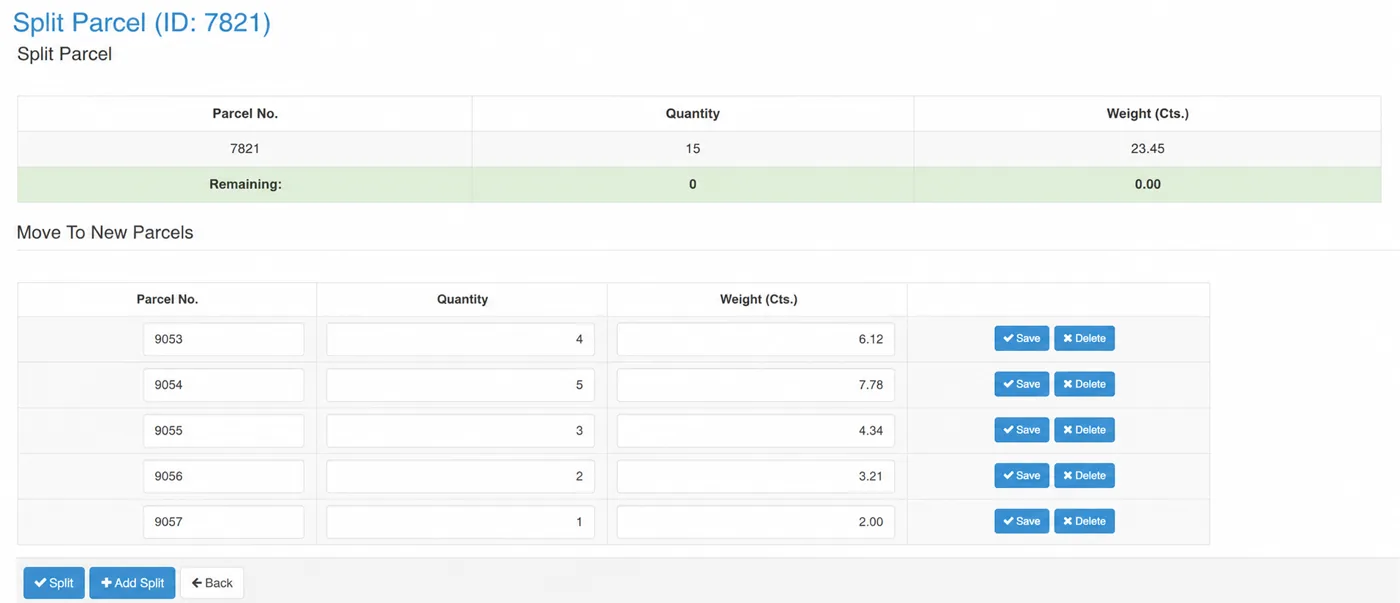
Split parcels need a clear cost decision
Splitting a parcel is not just a physical action. It is an accounting and operational decision.
A dealer may split a parcel because some stones are better quality, some are calibrated sizes, some match as pairs, some are suitable for memo, or some should be reserved for a specific customer. Each new parcel needs its own identity, quantity, description, location and cost basis.
There are several ways a business might handle the cost allocation. It may keep a straight average cost per carat. It may assign more cost to the higher-quality split. It may adjust values based on expected selling price. The right method depends on the dealer's business practice.
The important thing is that the decision should be recorded where the stock lives.
If a parcel is split in the safe but not split properly in the inventory system, the business ends up with two versions of reality. The physical stones say one thing. The stock list says another. Labels, memos, invoices and reports then start carrying small errors forward.
A useful gemstone inventory system should make the split visible and traceable. The original parcel should not simply disappear. The new parcels should be connected to the stock history, with quantities and costs that the team can review.
Merged parcels create the opposite risk
Merging parcels can be just as sensitive.
A dealer may combine two small groups of matching stones to create a stronger sales parcel. That can make commercial sense. It can also hide useful cost information if the original parcels had different costs, suppliers or purchase dates.
For example, one parcel may have been bought at an older lower cost, while another was bought recently at a higher cost. Once they are merged, the combined parcel needs a cost basis that reflects both sources. If that calculation is handled informally, later margin reports may look better or worse than reality.
The risk is not only financial. It is operational. If the business later needs to understand where a stone came from, which supplier it relates to, or why a certain price was set, the merged record should still preserve enough history to explain the decision.
Memos make parcel costing even more fragile
Memo workflows add another layer of complexity.
A parcel may be partly in stock, partly on memo with one customer, partly returned, and partly invoiced. If the system treats memo as a separate document disconnected from inventory, the team has to reconcile stock status manually.
That creates familiar questions:
- Is the missing quantity sold, still out on memo, or returned but not updated?
- Did the invoice come from the correct parcel or from a copied line item?
- Does the remaining parcel value reflect what has already been sold?
- Are reports showing outstanding memo stock separately from owned stock in the office?
For gemstone dealers, the memo document and the parcel record should not live in separate worlds. Memo, return and invoice activity should flow from the same stock record so the business can trust both quantity and value. A connected memo inventory workflow helps keep those parcel movements understandable.
Labels and parcel numbers are part of the control system
Labels are often treated as a practical convenience, but in a parcel-based business they are part of inventory control.
A good parcel number connects the physical tray or packet to the live stock record. When a parcel is split, the new labels should represent the new reality. When parcels are merged, the combined parcel should have a clear identity. When part of a parcel is sold, memoed or returned, the label and system should not disagree.
Problems start when labels are printed from old spreadsheets, copied from previous parcels, or manually adjusted without updating the source record. The label may look official, but the cost, quantity or status behind it may already be stale.
Barcode labels and scanner-friendly workflows help only when the barcode points to a trustworthy record. The label is useful because the inventory system behind it is current.
What better parcel tracking should do
A strong gemstone parcel workflow should help a team answer practical questions quickly:
- What did this parcel originally cost?
- How many carats or pieces remain?
- What has been sold, memoed, returned or closed?
- Has this parcel been split from another parcel?
- Has it been merged with other parcels?
- What cost basis is being used now?
- Which invoices, memos and reports are connected to it?
- Who changed the record and when?
This is where purpose-built gemstone inventory software differs from a generic stock table. The goal is not just to store a list of items. The goal is to preserve the operational history that explains the current stock position.
Carats.Online is designed around parcel-based gemstone workflows, including stock, memos, invoices, labels and reporting. For businesses that work with loose stones and parcels, that focus matters. The system supports parcel tracking through day-to-day changes, including split and merge activity, while keeping stock workflows connected to memos and invoices.
The real cost of unclear costing
Costing errors do not always announce themselves immediately.
They appear later as small doubts:
- A margin report does not match what the owner expected.
- A customer is quoted from an old cost assumption.
- A parcel appears profitable, but the best stones were already sold.
- A memo return is entered against the wrong remaining quantity.
- A team member hesitates because only one person understands the spreadsheet.
In a high-value inventory business, those doubts slow decisions. They also make growth harder. Adding more stock, more customers, more memos or more locations increases the number of moments where the system needs to be trusted.
If the business runs on parcel logic, the inventory system should understand parcel logic too.
A practical test for your current system
A simple way to evaluate your current inventory setup is to choose one active parcel and trace its full story.
Can you see the original purchase quantity and cost? Can you see every partial sale? Can you see what went on memo, what came back, and what was invoiced? If the parcel was split, can you explain how cost moved into the new parcel? If it was merged, can you still understand the source records? Can someone else on the team follow the same trail without asking the person who built the spreadsheet?
If the answer is no, the problem is not only reporting. It is daily control.
Gemstone businesses do not need unnecessary software complexity, but they do need records that match the way parcels actually move. When splits, merges and partial sales are handled clearly, the team can price with more confidence, invoice faster, and understand stock value without rebuilding the story every time.
That is the work a gemstone inventory system should quietly do in the background.