For many gemstone dealers, memo is where inventory control becomes difficult to trust.
A parcel may start in the safe, move to a customer on memo, come back partly returned, become partly invoiced, then sit with a balance that still needs to be offered elsewhere. If those steps are tracked across a stock spreadsheet, a memo document, an invoice folder, and a few chat messages, the team can usually manage it for a while. The problem is that nobody is looking at one reliable version of the parcel anymore.
Memo inventory needs more discipline than ordinary stock rows. It has to answer four practical questions every day: what is owned, what is out, what came back, and what can still be sold.
Memo inventory is not just another status column
A simple spreadsheet can mark a parcel as "on memo", but the actual workflow is more detailed than that.
A dealer may need to know which customer has the goods, which memo document was issued, when the goods are expected back, whether the parcel was split, which stones were returned, which stones were converted to an invoice, and what quantity or value remains outstanding.
That is why memo and consignment tracking often breaks when it is treated as a note beside inventory instead of part of the inventory workflow. The stock record, memo record, return record, and invoice record all need to describe the same movement of goods.
The common failure points
Most memo problems are not dramatic. They are small mismatches that compound over time.
A parcel is sent out, but the stock sheet still looks available. A customer returns part of a lot, but the returned balance is typed into a new row with a slightly different parcel reference. A memo is converted to an invoice, but the original memo document is not updated. A team member checks a spreadsheet before a trade show and offers goods that are already with another customer.
The result is not only administrative mess. It affects sales confidence. People hesitate because they are unsure whether the balance is real, whether the cost is right, or whether an item is still physically with the company.
Track the parcel, not just the paperwork
The safest approach is to make the parcel record the centre of the workflow.
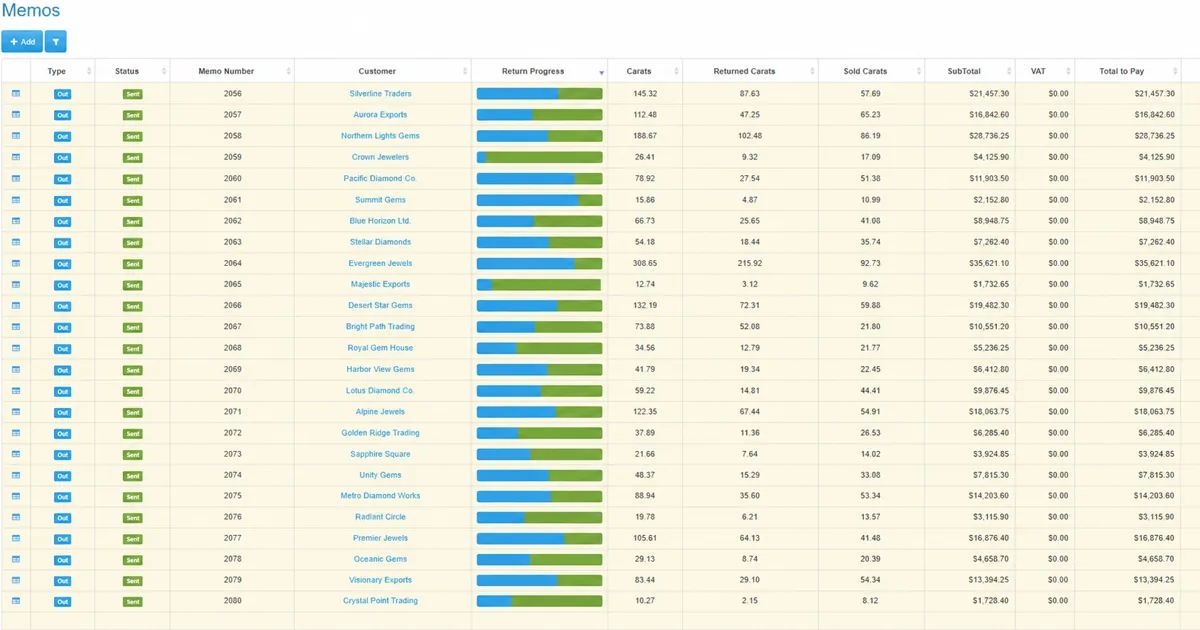
When an item goes on memo, the inventory system should show that movement from the stock record itself. When goods return, the return should update the same record or the correct child balance. When a sale happens, the invoice should be connected to the memo activity rather than recreated separately.
That structure makes it easier to answer practical questions:
- Which parcels are currently outstanding on memo?
- Which customer or agent has them?
- What quantities, carats, or values are still out?
- Which goods came back and when?
- Which memo items were invoiced?
- What stock is available to sell today?
The point is not to make the process complicated. It is to stop the team from rebuilding the truth manually each time someone asks where the goods are.
Keep memo, return, and invoice activity connected
In gemstone businesses, memo is often a temporary state between available stock and either return or sale. A clean workflow should preserve that chain.
If goods are returned, the system should make the returned stock available again with the right parcel reference, quantity, cost, and history. If goods are sold, the invoice should reduce the outstanding memo balance and show that those items are no longer available. If only part of a parcel is sold, the remaining balance should still be traceable.
This matters most when teams handle partial sales, mixed returns, and split parcels. A memo that starts as one lot can become several business events. Without connected records, cost and availability become easy to misread.
Use labels and references that survive the whole workflow
A memo process is easier to audit when parcel references and labels do not change casually.
Barcode labels, parcel numbers, customer references, and memo numbers should help the team connect the physical goods to the system record. If a parcel is split, the new records should still make sense in relation to the original parcel. If a memo is printed or exported as a PDF, the references on the document should match the live inventory record.
This is where spreadsheet-based systems often become fragile. A copied row can look correct while hiding an outdated status. A printed label can stay on a parcel long after the spreadsheet has moved on. A live inventory system should reduce those gaps by making labels, memos, returns, and invoices part of the same operational flow.
Watch outstanding memo stock like a report, not a memory test
Every memo-heavy business needs a clear view of outstanding goods.
That view should show which memos are still open, which customers have goods, how long the goods have been out, what value is outstanding, and what action is needed next. For a small team, this can be the difference between calm follow-up and constant checking.
A useful outstanding memo report is not just for accounting. It helps salespeople know what can be offered, managers understand exposure, and operations staff prepare returns or invoices without searching through old documents.
What to look for in memo inventory software
When evaluating gemstone inventory software, memo handling should be tested with real examples rather than a generic feature checklist.
Ask whether the system can track parcel-level stock, issue memo documents, process partial returns, convert memo items to invoices, preserve history, show outstanding goods, and keep costs or balances clear when parcels are split or merged.
Also ask how easy it is to use during a normal day. A powerful system that people avoid will not improve memo control. The right system should make the daily workflow clearer: select the goods, issue the memo, track what is out, receive returns, invoice what sold, and keep the stock position current.
A practical memo workflow
A reliable memo process usually looks like this:
- Start from the live parcel record.
- Select the goods being issued on memo.
- Create the memo document from the selected stock.
- Mark the goods as out on memo with the customer, date, and reference.
- Record returns against the original memo activity.
- Convert sold memo items into an invoice.
- Review outstanding memo stock regularly.
- Keep parcel history available for later checking.
The exact process can vary by business, but the principle is consistent: each event should update the same operational truth.
Where Carats.Online fits
Carats.Online is built around practical gemstone business workflows: stock, parcels, memos, invoices, labels, customers, suppliers, and reports. That focus matters because memo is not a side process for many dealers. It is part of how goods move, how customers buy, and how stock availability changes.
A focused system helps teams move away from separate spreadsheets and documents toward a clearer daily workflow. The goal is simple: know what is in stock, what is on memo, what returned, what sold, and what still needs follow-up.
For gemstone businesses that rely on memo, that clarity is often worth more than another column in a spreadsheet.
Need a clearer memo inventory workflow?
Carats.Online helps gemstone teams keep parcels, memos, returns, invoices, labels, and reports connected in daily work.
Request a demonstration